


The Plane That Lost Part of Its Roof at 24,000 Feet
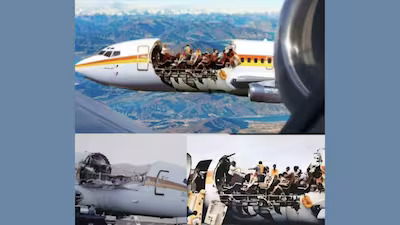
Aloha Airlines Flight 243, carrying 89 passengers and 5 crew members, departed from Hilo, Hawaii, on April 28, 1988, for a routine short flight to Honolulu. However, only minutes after reaching cruising altitude, the Boeing 737 reportedly suffered a sudden explosive decompression, causing a large section of the aircraft’s roof to tear away mid-air.
The incident shocked the aviation world, as the structural failure happened without warning during what was expected to be a normal inter-island flight. Despite the severe damage, the pilots managed to make an emergency landing, turning the flight into one of the most remarkable survival stories in aviation history.
According to investigation reports, a major section of the aircraft’s fuselage reportedly tore away during the flight, leaving much of the upper portion of the cabin completely exposed. Images released after the incident showed that a large part of the plane’s roof had detached mid-air, making the sky visible from inside the aircraft while passengers remained strapped into their seats.
The sudden structural failure triggered panic throughout the cabin. Passengers later described hearing loud explosions, screaming, and objects being blown around as powerful winds rushed into the aircraft. Oxygen masks automatically dropped from the ceiling while the Boeing 737 shook violently during the terrifying mid-air emergency.

During the mid-air decompression, flight attendant Clarabelle “C.B.” Lansing was reportedly swept out of the aircraft after a large section of the fuselage tore away. Despite extensive search operations carried out after the incident, she was never found, making her the only fatal victim of the disaster.
Inside the cockpit, pilot Robert Schornstheimer and co-pilot Madeline “Mimi” Tompkins immediately declared an emergency and began attempting to land the heavily damaged Boeing 737. Reports state that warning alarms continued sounding throughout the flight, while severe wind noise inside the cockpit damaged communication systems and made radio instructions difficult to hear.
Despite the catastrophic structural failure, the aircraft managed to remain airborne instead of crashing into the ocean. The pilots guided the plane toward an emergency landing at Kahului Airport on the island of Maui, even as the aircraft shook violently during descent. According to reports, the crew feared additional sections of the plane could collapse before reaching the runway, making the landing attempt extremely dangerous.
Emergency vehicles surrounded the airport as air traffic controllers prepared for the possibility of a crash landing while the heavily damaged aircraft approached Maui. Despite the severe structural failure and continuous shaking during descent, the pilots successfully landed the plane safely at Kahului Airport against all odds.
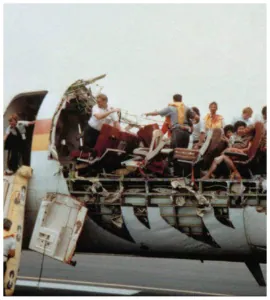
Rescue teams quickly evacuated injured passengers and crew members from the aircraft. Reports stated that 65 people suffered injuries of varying severity, while flight attendant Clarabelle “C.B.” Lansing remained the only fatal victim after being swept out of the plane during the decompression incident.
Images and footage of the damaged Boeing 737 shocked people around the world and drew widespread attention from aviation experts. The National Transportation Safety Board (NTSB) later concluded that metal fatigue and corrosion were major factors behind the fuselage failure. Investigators reportedly found that the aircraft had operated for years in Hawaii’s humid ocean environment, which contributed to the weakening of the plane’s structure over time.
The shocking incident later led to major changes in aircraft inspection and maintenance procedures across the aviation industry. Following the disaster, airlines and aviation authorities reportedly increased their focus on detecting corrosion, metal fatigue, and structural weaknesses in older aircraft, especially those operating in harsh coastal environments.
The story of Aloha Airlines Flight 243 is still remembered as one of aviation’s most extraordinary survival incidents. What began as a routine short-distance flight over Hawaii suddenly turned into a terrifying mid-air emergency above the Pacific Ocean, leaving passengers and crew fighting for survival after a catastrophic structural failure struck the aircraft.